Personalized Marketing Content: How to Create It at Scale
Personalized marketing content explained: what it is, the data it needs, examples, how to produce many versions fast, and how to measure results without losing trust.
Personalized marketing content is material that changes depending on who is reading, watching or listening: the message, the visual, the offer, the language or the channel. The idea is easy. The hard part is production. Every extra audience means another video cut, another caption, another voiceover, and most teams run out of hours before they run out of audiences. The teams that win treat personalization as a content-production problem first. They build one strong core idea, then produce many versions of it quickly. That is what an all-in-one AI creative studio like AiEnvoy is built for: video, music, images, voice and writing in one place.
TL;DR
- Personalized content adapts to an individual’s behavior, preferences and needs. Using a first name is the shallowest version of it.
- Start with first-party data (what people tell you and do on your own channels) and a handful of segments, not a thousand.
- The bottleneck is output: Deloitte Digital found demand for content rose 54% in 2023 while marketers could meet it only 55% of the time.
- Build content in reusable modules (hook, visual, body, call to action) so one idea becomes many versions.
- Wrong personalization hurts: a Gartner survey linked it to negative experiences for 53% of customers. Be transparent about what data you use.
Table of Contents
- What personalized marketing content actually is
- Why it is worth the effort
- The data behind the personalization
- Examples of personalized marketing content
- Formats and channels you can personalize
- Producing personalized content without burning out your team
- Keeping it relevant, not creepy
- How to measure results
- Start producing your first personalized set
- Our view: personalization is a production problem
- FAQ
- Sources
What personalized marketing content actually is
Acquia describes personalized marketing content as messaging, experiences and materials that adapt to individual characteristics, behaviors, preferences and needs, instead of sending identical content to everyone. It goes beyond a name in the subject line: dynamic web pages, tailored product recommendations, triggered emails and messages matched to the stage of the buyer’s journey.
Two terms get mixed up, so here is the difference:
- Segmentation sends each group of people a different message. Everyone in the “first-time buyers” group gets the same email.
- Personalization uses what you know or infer about one person. Econsultancy’s email report separates group-level customized messages from 1:1 personalization.
- Customization is different again. Martech.org explains that in personalization the business adapts the experience, while in customization the user changes settings or topics themselves.
In practice most campaigns sit on a ladder. BCG describes the progression from simple tag replacement (“Dear John”), to dynamic content driven by segment rules (show a burger image to burger lovers), to atomic content, where AI mixes and matches text and creative assets to build a unique piece for each customer. You do not need the top rung to get value. You need to know which rung your team can staff.
Why it is worth the effort
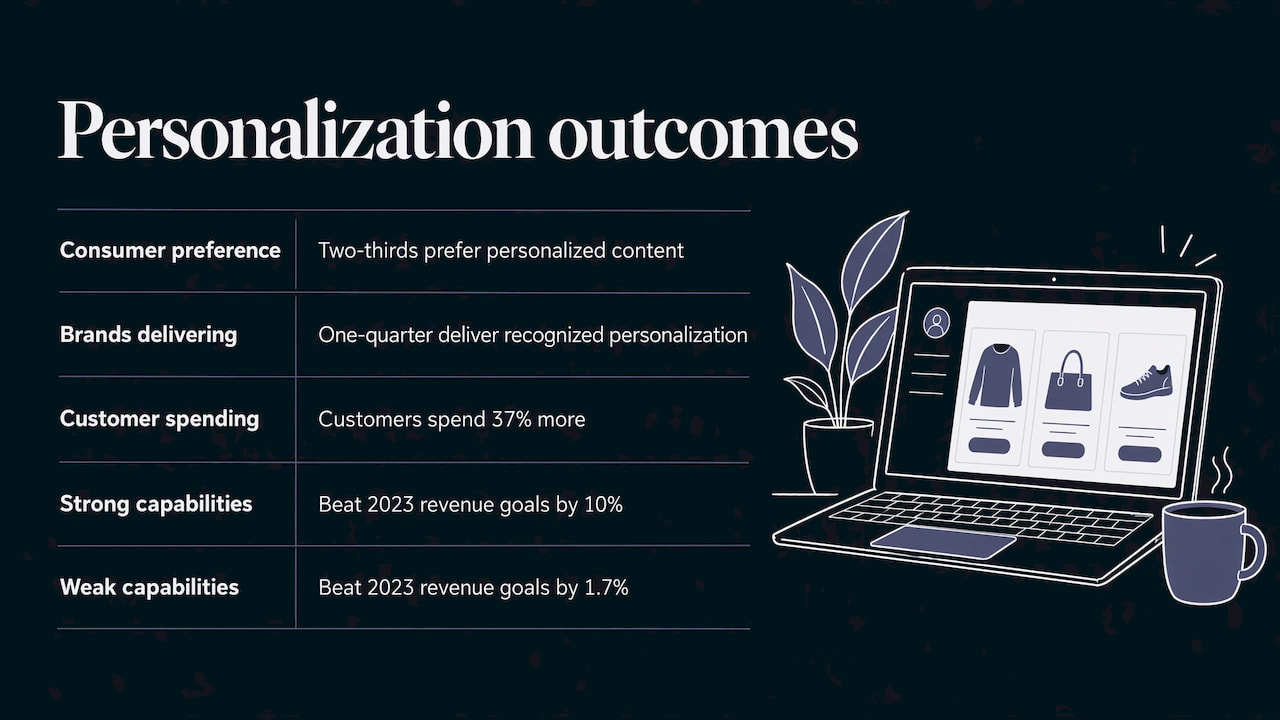
The consumer side is clear. In Deloitte Digital’s US research, two-thirds of surveyed consumers preferred brands that deliver personalized content showing they understand and anticipate their needs. Yet only a quarter of brands delivered the personalization consumers recognize.
The business side is just as direct. According to the same Deloitte study, customers of brands delivering timely, authentic personalized content spend 37% more on average. Brands with the strongest personalization capabilities beat their 2023 revenue goals by 10%, against 1.7% for brands with weaker capabilities. The IAB’s AI Personalization Playbook cites a figure of 80% of consumers being more likely to buy when brands offer personalized experiences.
Treat these as directional, not as a promise for your own numbers. They come from large surveys and your results depend on your audience, offer and execution. But they explain why the question for most marketing teams has shifted from “whether” to “how fast can we produce it.”
The data behind the personalization
Personalized content is only as good as the signal feeding it. You do not need a data science team. You need three kinds of information and a clean way to collect them.
Zero-party and first-party data
Econsultancy notes that with third-party cookie data fading, zero-party data (what people tell you through preferences, surveys and polls) and first-party data (email activity, website behavior) should be core resources for marketing decisions. For a small team that means:
- A short preference prompt at signup (topic, role, goal).
- Email click and open history.
- On-site behavior: pages viewed, downloads, purchases.
- Channel data: which platform each person actually engages on.
Pick segments you can actually serve
A workable process, based on Amplitude’s segmentation guide:
- Define what the segmentation is for (more trial signups, more repeat purchases, fewer unsubscribes).
- Collect and clean the data from behavioral analytics, CRM, social engagement and surveys.
- Map each segment to the channel where it responds, such as TikTok for younger audiences, LinkedIn for professionals, email for busy parents.
- Test, refine and repeat.
McKinsey’s guidance offers useful segment archetypes: discount-sensitive customers, product-preference customers, channel-preference customers, infrequent buyers and loyalty-program members.
Here is the rule we give creators and social teams: never define more segments than you can produce content for. Three segments with genuinely different videos beat twenty segments that all get the same video with a swapped headline.
Examples of personalized marketing content
The best examples are specific about the trigger and specific about the change.
- Behavior-triggered email. Klaviyo’s glossary gives the cart-abandonment email that names the exact item left behind, and flows split by cart value.
- Retargeting and landing pages. Semrush lists location-based apps, interactive quizzes, personalized landing pages, behavior-triggered emails and retargeting ads that show previously viewed products.
- AI-tailored messaging at scale. McKinsey describes a European telecom that tested about 2,000 different actions by text, then used gen-AI-enhanced messages tailored to age, gender and data usage. Over a few months, customers who received personalized messages engaged and acted 10% more often than those who did not.
- Reward-based segmentation. Shopify’s coverage of a haircare brand describes offering a launch preview to customers who had bought a specific fragrance. The principle works for any brand: reward the people who already love one thing.
Notice that none of these needs a different strategy per person. Each needs a trigger, a segment, and several content variants ready to go. The variants are where teams stall.
Formats and channels you can personalize
Personalization is not limited to email. Salesforce’s guide lists website, mobile app, email, SaaS web app, online ads, in-store, chat and call center as personalizable channels, using inputs such as location, source, buyer persona, time of day, device and behavior.
Each channel wants a different shape of content. The Pedowitz Group’s channel guide points out, for instance, that SMS has a 160-character limit, paid and social need aspect-ratio variants and frequency caps, and email benefits from modular templates and send-time optimization.
For the creators, musicians and social managers reading this, that translates into a practical list of what to vary:
| Element | What to vary | Example |
|---|---|---|
| Video hook | First 3 seconds per segment | Tutorial opening for beginners, results opening for experts |
| Video format | Aspect ratio and length per channel | Vertical short clip for social, longer cut for email or web |
| Language | Voice and captions per market | One product video dubbed for each region |
| Audio | Music mood per audience | Upbeat track for a launch teaser, calm track for a customer story |
| Visual style | Imagery per segment | Different art style or setting for each persona |
| Copy | Headline and call to action | Offer-led for discount-sensitive, feature-led for product-focused |
Producing personalized content without burning out your team
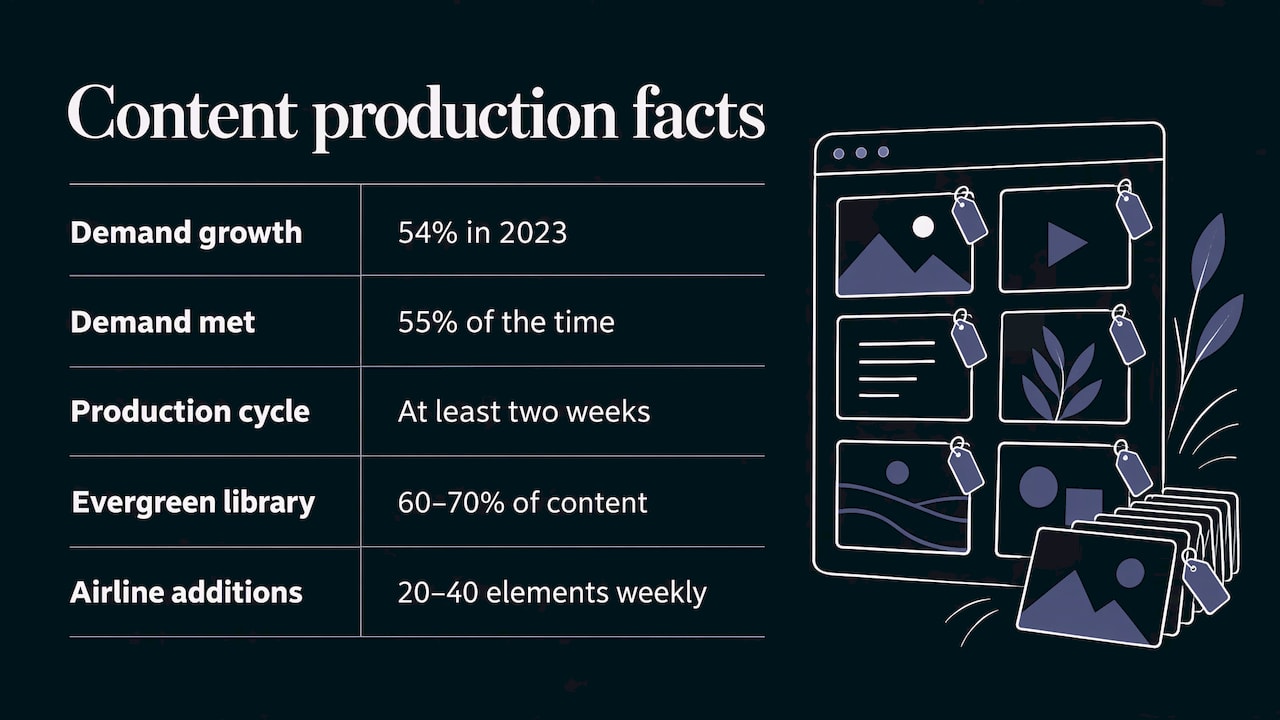
This is the real challenge. Deloitte Digital found that demand for content grew 54% in 2023 while marketers could meet it only 55% of the time. It also found most brands need at least two weeks to create and deliver personalized content. A two-week cycle makes “timely” personalization impossible.
BCG names three bottlenecks behind this: expensive multi-variant production, manual retrieval of creative assets, and adapting content to each destination’s format. Its answer is to store tagged creative components in a media management platform and keep a large evergreen library (60 to 70%) so the system can learn over time. It cites a major airline that added 20 to 40 new content elements every week.
Build in modules
Martech.org’s modular content guide explains that modular content splits a full piece into reusable parts (intro, visual, body copy, closing, call to action) that can be reassembled. Fewer new assets produce a far larger number of personalized versions.
A simple weekly routine for a small team:
- Write one core message and three audience angles.
- Produce the visual modules: one hero video or image set, plus alternate hooks.
- Localize and reformat: dub, caption and resize for each channel.
- Assemble the variants by segment and schedule them.
- Review the results per asset and keep the winners as your next evergreen modules.
The IAB’s playbook frames this as Briefing, Building and Benchmarking. The brief ties the AI work to brand strategy, audience segments, placement and KPIs. Building uses AI-augmented workflows, versioning and guardrails. Benchmarking combines automated and human checkpoints with asset-level performance measurement.
Where we take the production load off
Most of the steps above are production steps, and our platform covers them in one app instead of a stack of single-purpose tools:
- Step 2, visual modules. The AI Video Generator creates cinematic videos from text or images with models such as Sora, Kling and Veo, so alternate hooks do not need a reshoot. The AI Image Generator transforms images across artistic styles for segment-specific visuals.
- Brand consistency. Reusable AI character profiles keep the same character across every variant, which matters when ten versions of one idea must still look like one brand.
- Step 3, localization. AI Video Dubbing translates and dubs videos into multiple languages with natural AI voices. For teams that want it inside their own systems, the AI Dubbing API dubs videos into 50+ languages.
- Audio. The AI Music Generator produces songs and tracks, including AI lyric generation, so each audience can get its own mood.
- Copy and scheduling. AI Writing Tools help draft headline and caption variants, and AutoPilot handles automated content creation and scheduling. Our guide to social media content automation lays out a workflow that keeps quality up, and creative workflow automation covers the wider routine.
The point of consolidating is practical: modules created in one place are easier to reuse, relabel and reassemble than files scattered across six tools.
Keeping it relevant, not creepy
Personalization can backfire, and the evidence is specific. A Gartner survey of 1,464 B2B buyers and consumers, reported by Demand Gen Report, found personalized marketing generated negative experiences for 53% of customers. Those customers were three times more likely to regret a purchase and 44% less likely to buy again.
Econsultancy adds the mechanism: when personalization is wrong, or reveals information customers did not know the company held, the effect is unsettling instead of helpful. Bad personalization built on incomplete or outdated data breaks trust.
What to do about it:
- Say where it came from. The IAB playbook recommends clear data-usage messages such as “based on your purchase history,” accessible privacy controls and AI content labeling where applicable.
- Collect consent properly. Laws such as the EU’s GDPR and California’s CCPA govern consent and data use, so check the rules that apply to your audience’s location. Our privacy policy explains how data is collected and used on our own platform.
- Have a fallback. When a profile is thin, send the strong general version, not a guess.
- Review AI output. McKinsey stresses that organizations need ways to validate and govern gen-AI content against bias, toxicity and hallucinations. A human check before publishing is the simplest version.
- Do not over-engineer. Deloitte Digital warns that not every brand needs to go deep, and overly personalized efforts may see diminishing returns.
How to measure results
Measure at the level you personalize. If you build variants per segment, compare segment variants against the generic version, and track each asset separately. Deloitte found that 45% of respondents named analytics, testing and measurement as their biggest capability gap, so this step deserves a place on the calendar.
A lean scorecard:
- Engagement: watch time, click-through, replies, saves.
- Conversion: signups, purchases, trial starts per variant.
- Retention: repeat purchase rate, churn and customer lifetime value, which Mailchimp’s omnichannel guide recommends watching alongside A/B tests.
- Trust signals: unsubscribes, complaints, opt-in rates.
- Speed: days from idea to published variant. If it drifts back toward two weeks, your production process needs attention.
Keep winning hooks, visuals and tracks as evergreen modules and retire what underperforms. Over a quarter this gives you a library that improves each campaign.
Start producing your first personalized set
A good first project is small: one product video, three audience hooks, two languages. That is six versions from a single idea, and enough to learn which angle each segment responds to. We built our studio so that this kind of set takes one workspace, not six subscriptions. You can start on the free plan, which costs 0 USD per month, and see the Premium plan and Token Packs on the same page.
If you want to build personalization into your own product or pipeline, the text-to-video API, image-to-video API and translation API are listed on our API page.
Our view: personalization is a production problem
Most advice on personalized marketing content starts with data and stops before the hard part. Marketers already know they should tailor a message. What stops them is that every tailored version costs a shoot, an edit, a dub, a track.
We built AiEnvoy around that gap. Video, music, images, voice and writing live in one studio, so a single idea can become many versions without moving files between tools. Reusable AI characters keep the faces and voices consistent, and automated workflows keep the cadence going when the team is small.
Our position is simple: the winners will not be the teams with the most data. They will be the ones that can turn what they learn into finished content within days, not weeks. When production is cheap in time, you can test more hooks, serve more languages, and keep only what your audience responds to.
the author
FAQ
What is the difference between personalization and segmentation?
Segmentation sends different messages to different groups, so everyone in a group sees the same thing. Personalization uses what you know about an individual, such as past purchases or clicks, to adapt the content for that person. Most teams start with segmentation and add personalization as their data and production capacity grow.
What are some examples of personalized marketing content?
Cart-abandonment emails that name the exact item, retargeting ads showing products someone viewed, landing pages that change by source or location, and videos with a different hook or language per audience. McKinsey describes a telecom whose personalized text messages drew about 10% more engagement than non-personalized ones.
What data do I need to start?
Start with first-party data: email activity, on-site behavior, purchases, and preferences people give you directly. Add a short preference question at signup. You can build useful segments from just these sources, and they remain usable as third-party cookies fade.
How many versions of a piece of content do I need?
Only as many as you can produce well and measure. A practical start is one core idea with three audience hooks, plus the languages your audience actually speaks. Keep the versions that win as reusable modules.
Can personalization go wrong?
Yes. Gartner’s survey found 53% of customers reported negative experiences with personalized marketing, usually tied to irrelevant or intrusive messages. Use accurate data, tell people why they are seeing something, offer privacy controls and keep a sensible default for incomplete profiles.
Sources
- What is personalization? Guide to personalized marketing (Martech.org)
- Email Marketing Best Practice: Segmentation and Personalisation (Econsultancy)
- Taking the Atomic Approach to Personalized Content (BCG)
- Personalization in the content lifecycle (Deloitte Digital)
- AI Personalization Playbook (IAB)
- What Is Audience Segmentation? (Amplitude)
- The next frontier of personalized marketing (McKinsey)
- What is Content Personalization? (Klaviyo)
- Content Personalization: What It Is & How to Do It (Semrush)
- What is Marketing Personalization? (Salesforce)
- How does dynamic content adapt per channel? (Pedowitz Group)
- How to produce modular content to drive personalization at scale (Martech.org)
- Gartner survey on the pitfalls of personalization (Demand Gen Report)
- How to Personalize Omnichannel Campaigns (Mailchimp)
Recommended
Put this workflow into practice with AiEnvoy
Create videos, AI music, and multi-language dubbing with Sora, Kling, Veo, and Seedance 2.5 — or connect our Developer APIs.