How to Write Product Descriptions That Sell, Faster
A practical process for writing product descriptions: research, features to benefits, structure, a template and an AI workflow that keeps copy accurate and fast.
A good product description answers the questions a shopper would ask if they could pick the product up, and it does so in the first few lines. The fastest way to write dozens of them is a repeatable process: gather facts once, turn each feature into a benefit, fill a fixed template, and use AI for the first draft while a person checks every claim. With AiEnvoy’s AI writing tools you can run that process in the same studio where you make the product videos, images and audio that sit beside the copy.
TL;DR
- Start with facts and customer language, not adjectives. Specs, objections and buyer questions come first; wording comes second.
- Lead with the benefit or outcome, then back it with the feature that makes it true.
- Keep copy skimmable: a hook, a short benefit paragraph, bullets for details, and one proof point.
- Use AI for first drafts and variations, but feed it structured product data and have a person approve every description.
- Build a template once, then reuse it across your whole catalog and every channel.
Table of Contents
- What a product description has to do
- Step 1: Research before you write
- Step 2: Turn features into benefits and outcomes
- Step 3: Structure the description for skimmers
- Step 4: Write for search without ruining the copy
- Step 5: Use AI to write faster without inventing facts
- Step 6: Reuse the description across channels
- Common mistakes to fix before you publish
- Our view: copy and creative should come from one workflow
- Put the process to work in AiEnvoy
- FAQ
- Sources
What a product description has to do
A product description is the copy that explains what a product is, who it is for and why it is worth buying. Online, it carries the whole job of a salesperson. Nielsen Norman Group’s research found that shoppers cannot touch, try on or ask about a product, so the page has to answer their questions directly and help them compare options.
That shapes everything below. The same research notes that users skim and read more at the beginning, so the first lines must help them understand the product, and that even one line that answers no product question can put a shopper off. Every sentence either answers a question or earns its place by making the answer easier to believe. If it does neither, cut it.
For marketers and social media managers, the description is also the source text for everything else: ad copy, captions, email blurbs, video scripts. Getting it right once saves rewriting it five times.
Step 1: Research before you write
Most weak descriptions are weak because the writer started with a blank page and a spec sheet. Spend fifteen minutes on inputs and the writing speeds up.
Gather these six things, which a copywriting research guide lists as the inputs to collect before drafting:
- Customer language. The exact words buyers use in reviews, support tickets and call notes.
- The buying trigger. What happened that made them look for this product now.
- Objections. What makes them hesitate: price, fit, setup, durability.
- Awareness level. Whether they already know your product category or need it explained.
- Competitor claims. What similar products promise, so you can be specific where they are vague.
- Proof. Numbers, case studies, named reviews.
Talk to the people who already hear the objections. ProCopywriters, a professional body for commercial writers, points out that sales teams hear customer objections and questions every day and know which language resonates, which makes them an underused source. It also advises writing your research into a shared summary so disagreements surface before drafting starts.
If you have no time for interviews, write down your assumptions and check them later. One approach from Kickoff Labs is to list five competing products, five common customer traits, five objections and twenty keywords, then test them with customer interviews. Even a rough list like this beats guessing.
A quick fact sheet
For each product, keep one record with labeled fields: name, materials or components, dimensions, compatibility, care or usage, who it is for, the top three benefits, the top three objections, and one proof point. You will use this record for human writing and, later, as the input for AI. Products with missing fields get flagged before anyone writes a word.
Step 2: Turn features into benefits and outcomes
A feature says what the product is. A benefit says what that does for the buyer. An outcome pictures life after purchase. Forged Catalyst describes this three-level progression and gives an apparel example:
| Level | Example |
|---|---|
| Feature | Made with 100% organic Pima cotton |
| Benefit | Softer against your skin than regular cotton |
| Outcome | Finally, a shirt you’ll actually want to wear all day |
The strongest descriptions layer all three, leading with the benefit or outcome and using the feature as support.
The “so what?” test
Read each feature aloud and ask, “So what?” until you reach something the buyer cares about. A 20,000 mAh battery is a feature. “Charges your phone four or five times between outlets” is a benefit, provided that figure is true for your product. A stainless steel bottle with double-wall insulation becomes “keeps coffee hot through a long commute.”
Be specific, put the product in a moment
Yoast’s ecommerce copywriting guide recommends putting the product in a real moment: “fits in your jacket pocket on a rainy commute” says more than “compact.” It also favors precision over cleverness: “Save 3 hours a week” beats “Boost productivity.” Replace every vague adjective (premium, high-quality, innovative) with a number, a material or a situation.
Step 3: Structure the description for skimmers
People scan product pages. Nielsen Norman Group advises descriptions that are complete but not wordy, with relevant details such as dimensions, care instructions and use scenarios, and without marketing-heavy prose. Forged Catalyst suggests 2 to 3 sentence paragraphs, bullets, bold key benefits and subheadings so a visitor grasps the key points in about 10 seconds.
A four-part structure covers most products, and it matches the template The Good lays out:
- A descriptive headline that hooks with the main benefit.
- A benefit-focused paragraph of two to four sentences.
- A bulleted list of key details and features.
- A motivator: a review, a rating, a guarantee, or a clear call to action.
A worked example
Say you sell a travel coffee mug.
Headline: Hot coffee from your first meeting to your last
Benefit paragraph: Your coffee stays hot for hours, so the cup you pour at 7 a.m. is still worth drinking at lunch. The flip lid closes with one hand, and the stainless steel body survives the bottom of a gym bag.
Details:
- Double-wall vacuum insulation
- Stainless steel body
- Flip lid with a safety lock
- Fits standard cup holders
- Hand wash recommended
Proof: Add one real review or rating line here.
Notice that the numbers (how many hours, what capacity) must come from your fact sheet, not from instinct. If you cannot back up “hot for 15 hours,” do not write it.
Keep it consistent with the specs
A product information glossary from AtroPIM warns that descriptions contradicting the specifications confuse shoppers and lead to returns. The copy and the spec table must say the same thing. When you edit one, check the other.
Step 4: Write for search without ruining the copy
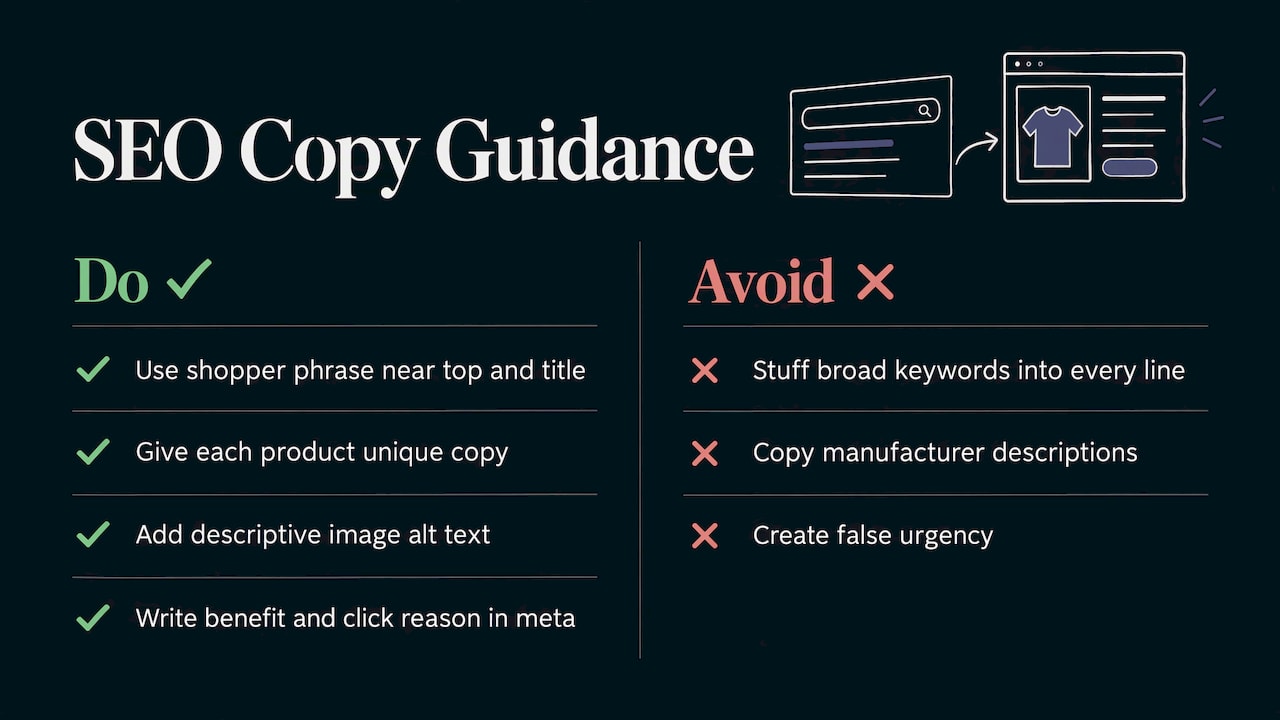
Search optimization is mostly clarity. Use the phrase a shopper would type once, naturally, near the top, and in a heading or the page title. Then write for people. Long-tail phrases that match specific needs, like “lightweight trail running shoes for wide feet,” describe a real buyer and tend to read better than a broad keyword stuffed into every line.
Give every product its own unique description. Copying the manufacturer’s text means your page says exactly what every other seller’s page says. Add descriptive alt text to product images and write a meta description that states the main benefit and a reason to click.
Avoid manufactured urgency. Yoast’s guidance is that urgency should only appear when it is real, because false scarcity breaks trust, and that small reassurances next to the price, like “No hidden fees,” ease hesitation.
Step 5: Use AI to write faster without inventing facts
The time sink in product copy is volume: fifty products, three channels each, several versions per channel. AI helps with exactly that, producing first drafts and adapting messaging across audiences. The catch is accuracy. A model that does not know your product will fill gaps with plausible-sounding details.
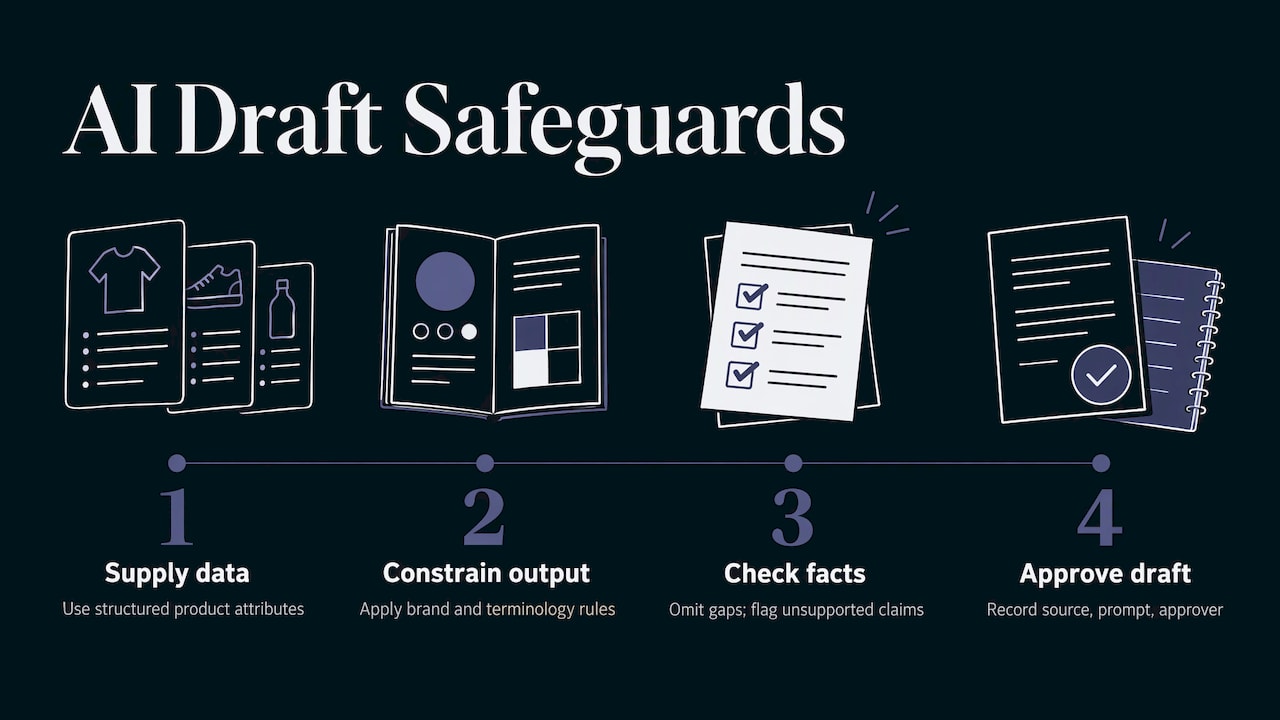
Two industry sources agree on the fix. PoliteTech argues that factual content should come from structured product data, not the model: pass labeled attributes such as material, dimensions, care and compatibility, tell the model to omit rather than guess a missing attribute, and check for unsupported facts before human review. PIM Atlas puts it as three conditions: the model writes only from structured attributes, brand and terminology rules constrain the output, and a person approves each description before it goes live. It adds that every generated description should be treated as a draft, with its source, prompt and approver recorded.
A workflow that works
- Prepare the fact sheet. The record from Step 1 becomes your input. Do not generate for products with empty fields.
- Write one prompt you reuse. Include the audience, the tone, the four-part structure and a rule: use only the facts supplied, and leave out anything missing.
- Give examples of your voice. Paste two or three descriptions you are proud of so the draft sounds like your brand.
- Generate, then compare to the fact sheet. Check every number, material and claim against the record.
- Edit for authenticity. Cut generic phrases, add the customer language you collected, and sharpen the hook.
- Approve and log. Someone signs off before publishing.
Inriver’s guidance on AI product content reaches the same place: AI speeds first drafts, but quality does not scale automatically, so teams should require human review before publication and keep people involved in evaluative and creative work.
Review what the draft says, and how it performs
Once descriptions are live, treat them as testable. Compare conversion and engagement per product page, and refine the winners into your template. A practical overview of using AI for marketing shows how to bring advertising and analytics data into that loop so you can see which wording earns clicks and which wastes spend.
Step 6: Reuse the description across channels
One well-researched description can feed an entire campaign. The headline becomes an ad line. The benefit paragraph becomes an email blurb. Each bullet becomes a caption or a talking point in a short video. The “moment” you wrote (the commute, the gym bag) becomes a scene.
This is where an all-in-one creative studio saves the most time. Instead of rewriting the same product story in a copy tool, a video tool and a design tool, you keep it in one place and adapt it. AiEnvoy covers video, music, images and voice in one app, so the benefit line you just wrote can become a short product clip, a branded image or a dubbed version for another market without exporting between apps.
Common mistakes to fix before you publish
- Copying the manufacturer’s text. It is duplicated across the web and says nothing about your buyer.
- Adjectives instead of facts. “Amazing quality” invites doubt; a material and a number invite trust.
- A wall of text. Break it into short paragraphs and bullets.
- Burying the point. The first line should say what the product does for the buyer.
- Unchecked AI output. Every number and claim should match your records.
- *One description for every audience. Buyers at different awareness levels need different openings. A newcomer needs the category explained; a returning buyer needs what is new.
Our view: copy and creative should come from one workflow
We built AiEnvoy around a simple observation: the people who write product copy are rarely only writing product copy. A marketer or social media manager has to turn one product story into a description, a short video, a visual and sometimes a voiceover in another language, and moving that story between separate tools is where the time goes.
That is why we put AI writing tools, cinematic video generation with models like Sora, Kling and Veo, image transformations, music and dubbing in a single studio. You write the description once, with the research and structure above, and carry its language into everything else. Reusable AI character profiles help keep a recurring on-screen presenter consistent, and a library of templates gives you a starting point instead of a blank canvas.
Our approach to AI is that it should take the repetitive work off your hands so you spend your time on the part only you can do: knowing your customer and deciding what is true and worth saying.
the author
Put the process to work in AiEnvoy
If you manage a catalog or a steady content calendar, the fastest setup is to draft descriptions with AiEnvoy’s AI writing tools, then turn the same product story into a video, image or audio track in the same studio. You can start on the Free plan at $0 per month, and Premium and Token Packs are listed on the pricing page.
For recurring output, AutoPilot is built for automated content creation and scheduling, and the templates library gives you ready-made starting points for campaigns.
FAQ
How long should a product description be?
Long enough to answer the buyer’s real questions, and no longer. Simple products may need only a headline, a short paragraph and a few bullets. Complex products need more detail on compatibility, dimensions or care. Nielsen Norman Group’s advice is to be complete but not wordy, so measure by questions answered, not by word count.
What is the difference between features and benefits?
A feature is a fact about the product, such as its material or size. A benefit is what that fact does for the buyer, such as staying comfortable all day or fitting in a pocket. Strong descriptions lead with the benefit and use the feature as proof.
Can AI write product descriptions for me?
Yes, for first drafts and variations. Give the AI labeled product facts, a few examples of your brand voice and a clear structure, and tell it to leave out anything it does not know. Then have a person check every number and claim against your records before publishing.
How do I write product descriptions faster across many products?
Build a fact sheet and a four-part template once, then reuse them for every product. Generate drafts from the structured data, edit for voice, and approve in batches. The same descriptions can then feed your ads, emails, captions and short videos.
Sources
- Tips for Better Product Descriptions on Websites, Nielsen Norman Group
- Copywriting Research: What to Gather Before You Write, Articos
- Research and Discovery, ProCopywriters
- Audience Research for Conversion Focussed Copywriting, Kickoff Labs
- Product Description Copywriting, Forged Catalyst
- Ecommerce Copywriting Tips for Better Sales, Yoast
- How To Write Powerful Product Descriptions That Sell, The Good
- What is a Product Description?, AtroPIM
- Generative AI for Ecommerce Product Content, PoliteTech
- Generative AI for product descriptions: quality and governance, PIM Atlas
- Using AI for product content creation, Inriver
Recommended
Put this workflow into practice with AiEnvoy
Create videos, AI music, and multi-language dubbing with Sora, Kling, Veo, and Seedance 2.5 — or connect our Developer APIs.